
Multi-tenant publishing
Customer pages are designed to publish as data inside one PageLinker runtime, avoiding a separate Git build and deployment for each page.
Product case study / Public beta
The core problem is not just generating attractive HTML. A usable landing-page product has to connect campaign intent, design quality, editing, publishing, lead capture, analytics, assets, authentication, and hosting into one workflow that a non-developer can operate.
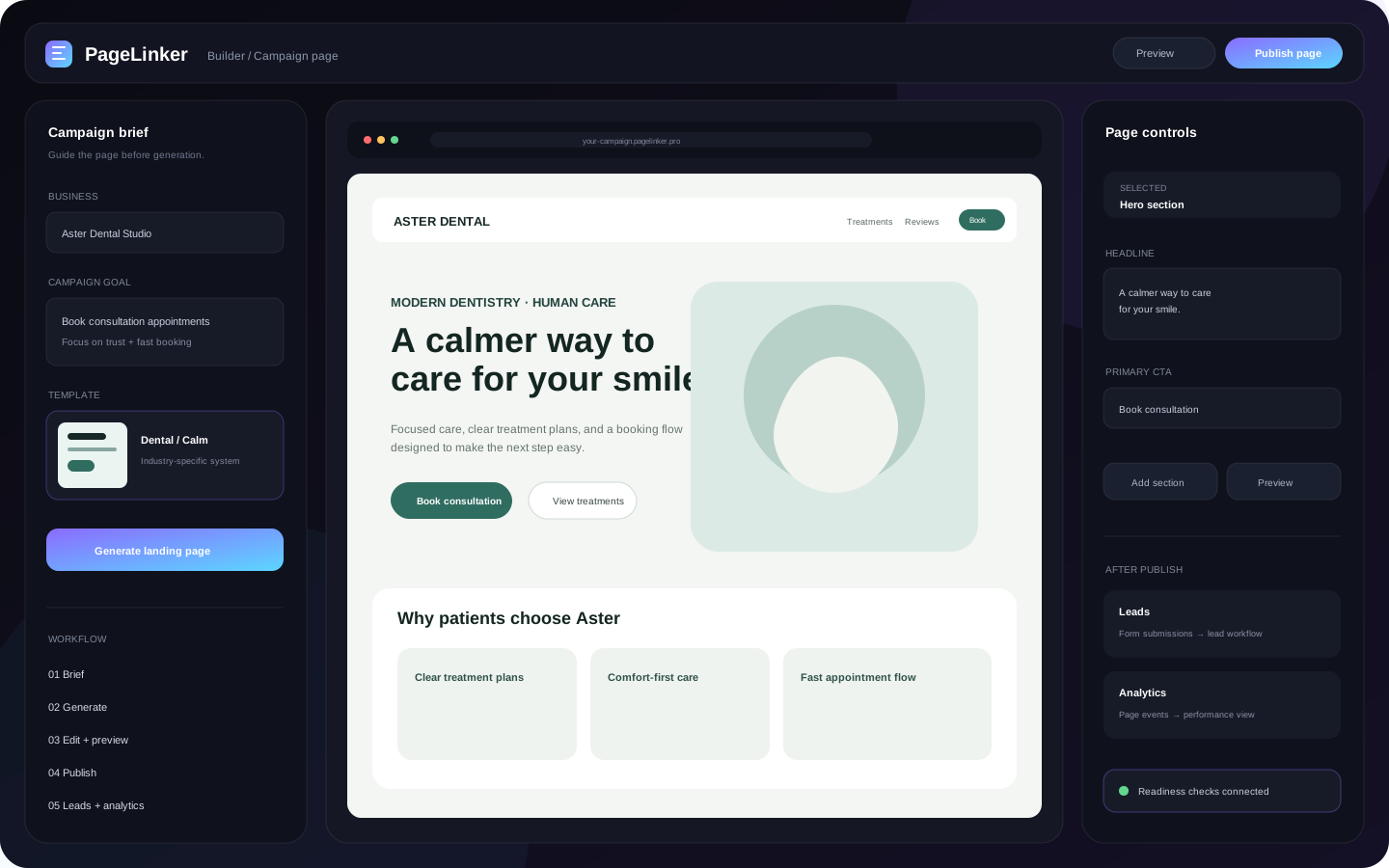
01 / Product boundary
PageLinker starts with a campaign or business brief and carries that context through page generation, template choice, visual editing, preview, publishing, and the lead workflow. The design target is a connected product journey, not a set of disconnected builder screens.
The codebase includes routes and product modules for the dashboard, editor, previews, templates, leads, analytics, generation, assets, authentication, publishing data, and public page delivery. The product is publicly accessible in beta and remains in active development. This case study describes implemented architecture and ongoing work rather than claiming a finished commercial release.
02 / System decisions
Customer pages are designed to publish as data inside one PageLinker runtime, avoiding a separate Git build and deployment for each page.
The architecture is built around Next.js on Cloudflare Workers, D1 for product data, and R2 for customer assets.
The editor is a first-class product surface, with page state, patches, previews, versions, and publishing readiness treated as product concerns.
Industry templates are separated so a dental page does not inherit the visual identity of a gym, restaurant, or real-estate page.
Lead capture is connected to a management workflow instead of ending at a contact form submission.
Generation quotas, request security, form security, rate limiting, asset handling, and publishing checks live alongside the UI work.
03 / What this demonstrates
Designing account, data, asset, publishing, and public-delivery boundaries around one maintainable product.
Connecting the campaign brief, landing-page structure, forms, leads, and analytics instead of treating conversion as copy alone.
Building shared product primitives while preserving distinct visual identity where templates need to feel specific to their market.
Treating authentication, permissions, publish readiness, security checks, responsive states, and QA as part of the product experience.
Need a similar product system?